
Team Effectiveness
Building the trust, alignment and shared ways of working that make teams perform.
Understand how the team builds trust, makes decisions, stays aligned and holds itself to account.
You don't need to diagnose the problem before you begin.
The first question is what you are trying to understand, not which assessment to buy. Leadership Lens™ provides one connected way of seeing leadership at three levels. We start wherever the question sits, and widen or deepen the view only when the evidence calls for it.
Leadership Lens™
How each leader thinks, decides and shows up.
Team Effectiveness™
How the team really operates: trust, alignment, decisions and accountability.
Organisational Insights
The wider conditions shaping how teams and leaders perform.
The questions that bring leaders to this work.
Why is a capable team not operating as effectively as it should?
Where are clarity, accountability or decision-making breaking down?
Why does leadership intent not match team experience?
What is making execution harder than it should be?
Are pressure or organisational conditions affecting performance?
Is the issue local to one team, or broader than that?
If any of these sound familiar, you are in the right place. The starting point is a conversation, not a commitment to a particular assessment.
Understand how the team is really operating.
Strong individuals do not automatically create an effective team. What determines performance is how those people work together: how they build trust, make decisions, handle conflict and hold each other to account.
Team Effectiveness™ makes those dynamics visible and develops them deliberately, grounded in the team's real context rather than a generic template.
The dimensions that shape how a team performs
Trust
The foundation that makes honesty and challenge possible.
Alignment
Shared understanding of direction, priorities and purpose.
Collaboration
How the team works across boundaries and roles.
Conflict
Turning disagreement into better thinking rather than friction.
Decision quality
How the team makes and commits to decisions.
Accountability
How the team holds itself and each other to what matters.
Team dynamics
The patterns that shape how the team functions day to day.
Performance conversations
Honest, constructive conversations that raise the bar.
Shared ways of working
Agreed norms that make performance repeatable.
Move beyond opinion.
Team conversations often run on impressions: who thinks what, whose voice carries, which frustrations get aired. Structured team insight replaces impressions with a shared, honest picture.
The team sees what is working, where experience diverges between the leader and the team, and where acting will make the most difference. That shared picture is what makes the development conversation honest and productive.
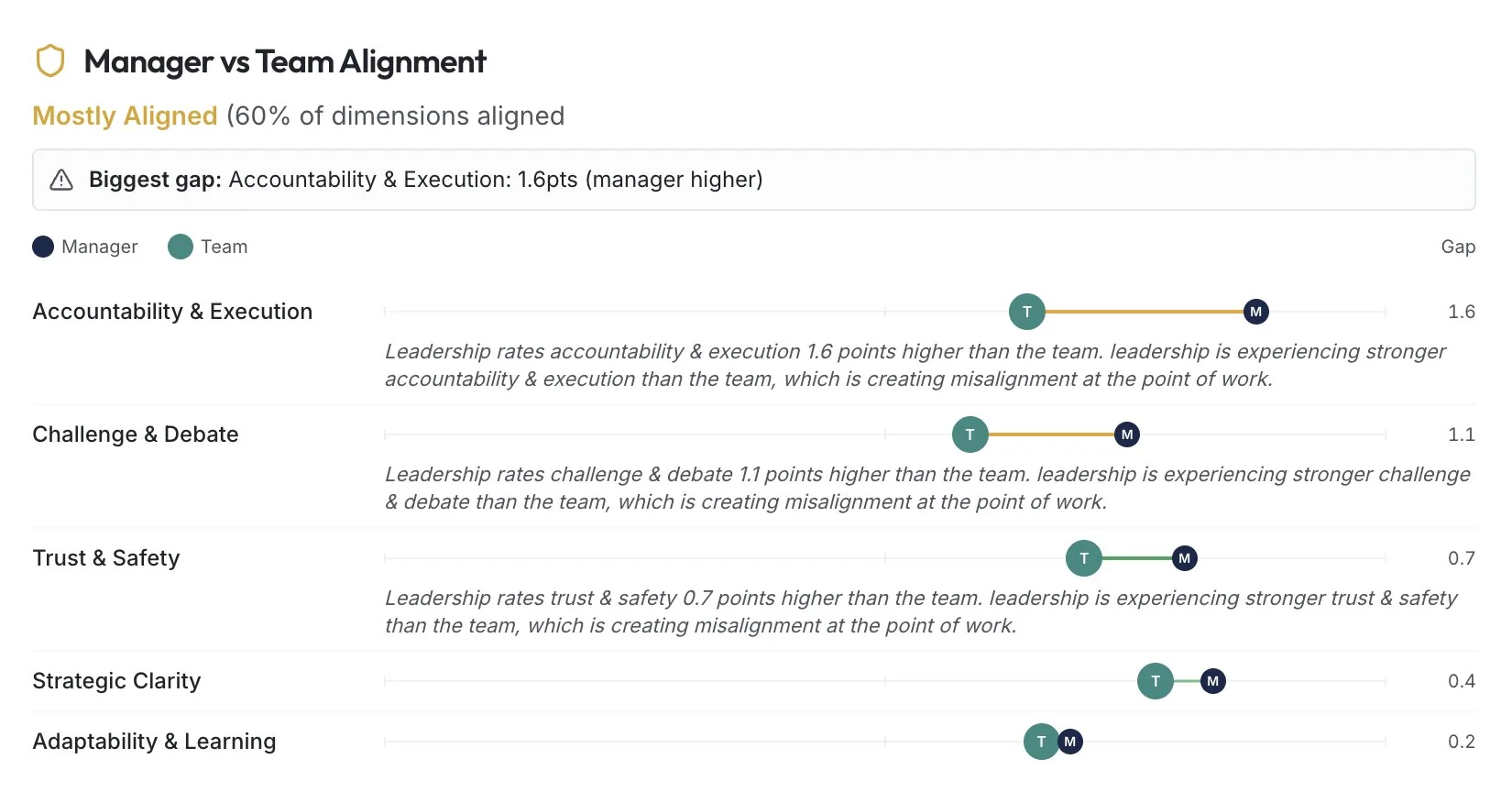
Where leadership intent and team experience diverge, made visible side by side. Example report view.
Start where the signal appears. Go deeper only when the evidence requires it.
Insight can begin at either level. A team question may surface an organisational pattern; an organisational question may point to specific teams. We use the depth of assessment needed to answer the question, no more and no less.
Team Signal
Something in how the team is operating draws attention.
Pattern
The same signal appears across conversations, teams or time.
System Question
The question shifts from this team to the conditions around it.
Organisational Insight
The wider system is examined at the depth the question requires.
Modular by design.
- ·Approved team assessment and report outputs
- ·Leadership Alignment insight where relevant
- ·Facilitated interpretation and debrief
- ·Clear priority areas
- ·A team action conversation
The exact configuration depends on the question you are trying to answer, the size of the group and the depth of insight required.
A consistent path from evidence to action.
Understand
Gather the evidence: how the team or organisation is actually experienced.
Interpret
Make sense of the patterns together, in plain terms.
Prioritise
Agree the few areas where effort will genuinely shift performance.
Act
Turn insight into deliberate action, at team or organisational level.
You don't need to know which assessment you need.
Tell us what you are trying to understand or improve. We can determine whether the right starting point is Team Effectiveness, Organisational Insights or a different level of Leadership Lens™ insight.